Code
x <- seq(-1, 2, length.out = 800)
plot(x, dunif(x, 0, 1), type = "l", lwd = 3, col = "#2166AC",
     xlab = "x", ylab = "Density", main = "PDF of Uniform(0, 1)",
     ylim = c(0, 1.15), bty = "l")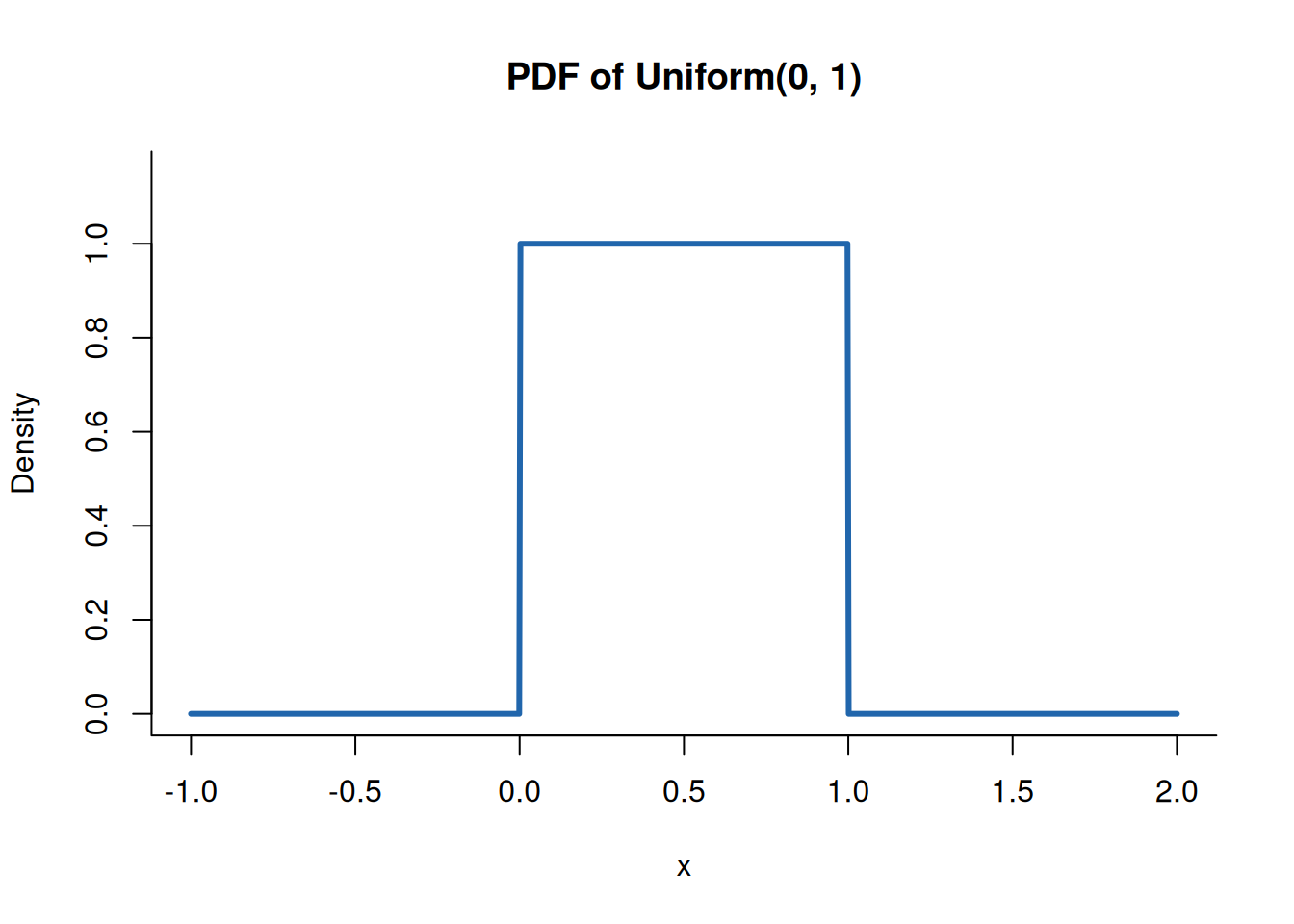
The earlier density page represented continuous probability by area. Suppose a psycholinguistic experiment places an auditory cue at a randomized time between 200 and 800 ms after word onset, with equal width intervals inside this window equally probable. What density makes every equal-width interval equally likely?
The answer is a rectangle whose total area is one. More specifically, the continuous uniform distribution represents a constant density across a bounded interval. Write
X\sim\operatorname{Uniform}(a,b), \qquad a<b.
For the cue procedure, a=200 and b=800.
The support width is
b-a.
If the constant density height is h, the rectangular area must equal one:
h(b-a)=1.
Solving gives
h=\frac{1}{b-a}.
Thus the PDF is
f_X(x)\equiv \begin{cases} \dfrac{1}{b-a} & \text{if }a\leq x\leq b,\\ 0 & \text{otherwise}. \end{cases}
For the 200 to 800 ms window, the width is 600 ms and the density height is
\frac{1}{600}
per millisecond.
First graph the unit-uniform density.
x <- seq(-1, 2, length.out = 800)
plot(x, dunif(x, 0, 1), type = "l", lwd = 3, col = "#2166AC",
xlab = "x", ylab = "Density", main = "PDF of Uniform(0, 1)",
ylim = c(0, 1.15), bty = "l")
For X\sim\operatorname{Uniform}(0,1),
\mathbb P(.25<X<.75) =\int_{.25}^{.75}1\,\mathrm dx =.50.
The shaded area in the next graph is this probability.
plot(x, dunif(x, 0, 1), type = "l", lwd = 3, col = "#2166AC",
     xlab = "x", ylab = "Density",
     main = "Probability mass of (.25, .75) under Uniform(0, 1)",
     ylim = c(0, 1.15), bty = "l")
polygon(c(.25, .25, .75, .75), c(0, 1, 1, 0),
        col = adjustcolor("#B2182B", alpha.f = .45), border = NA)
lines(x, dunif(x, 0, 1), lwd = 3, col = "#2166AC")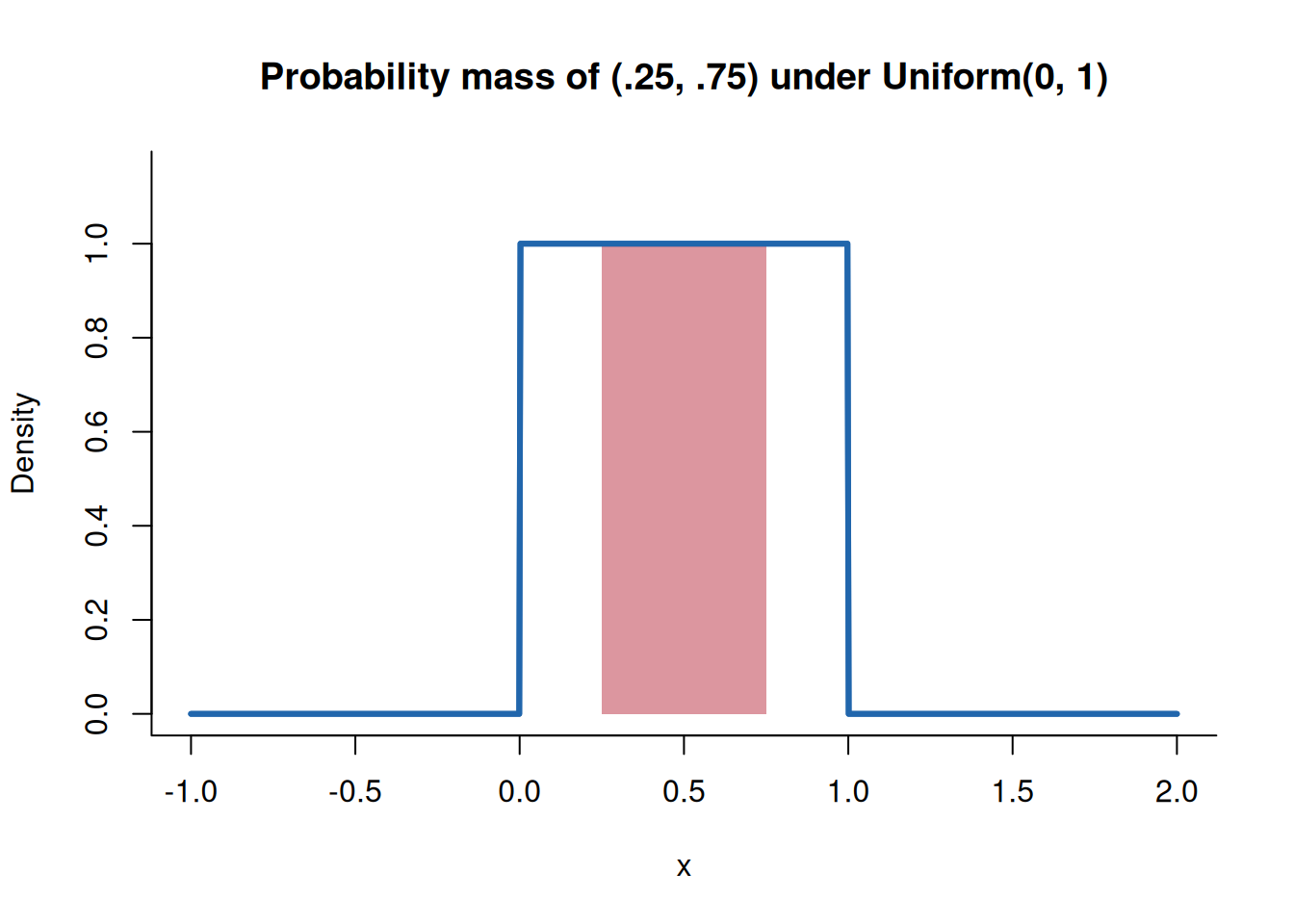
The CDF is
F_X(x) \equiv\mathbb P(X\leq x) = \begin{cases} 0,&x<0,\\ x,&0\leq x\leq1,\\ 1,&x>1. \end{cases}
plot(x, punif(x, 0, 1), type = "l", lwd = 3, col = "#2166AC",
     xlab = "x", ylab = "Cumulative probability",
     main = "CDF of Uniform(0, 1)", ylim = c(0, 1), bty = "l")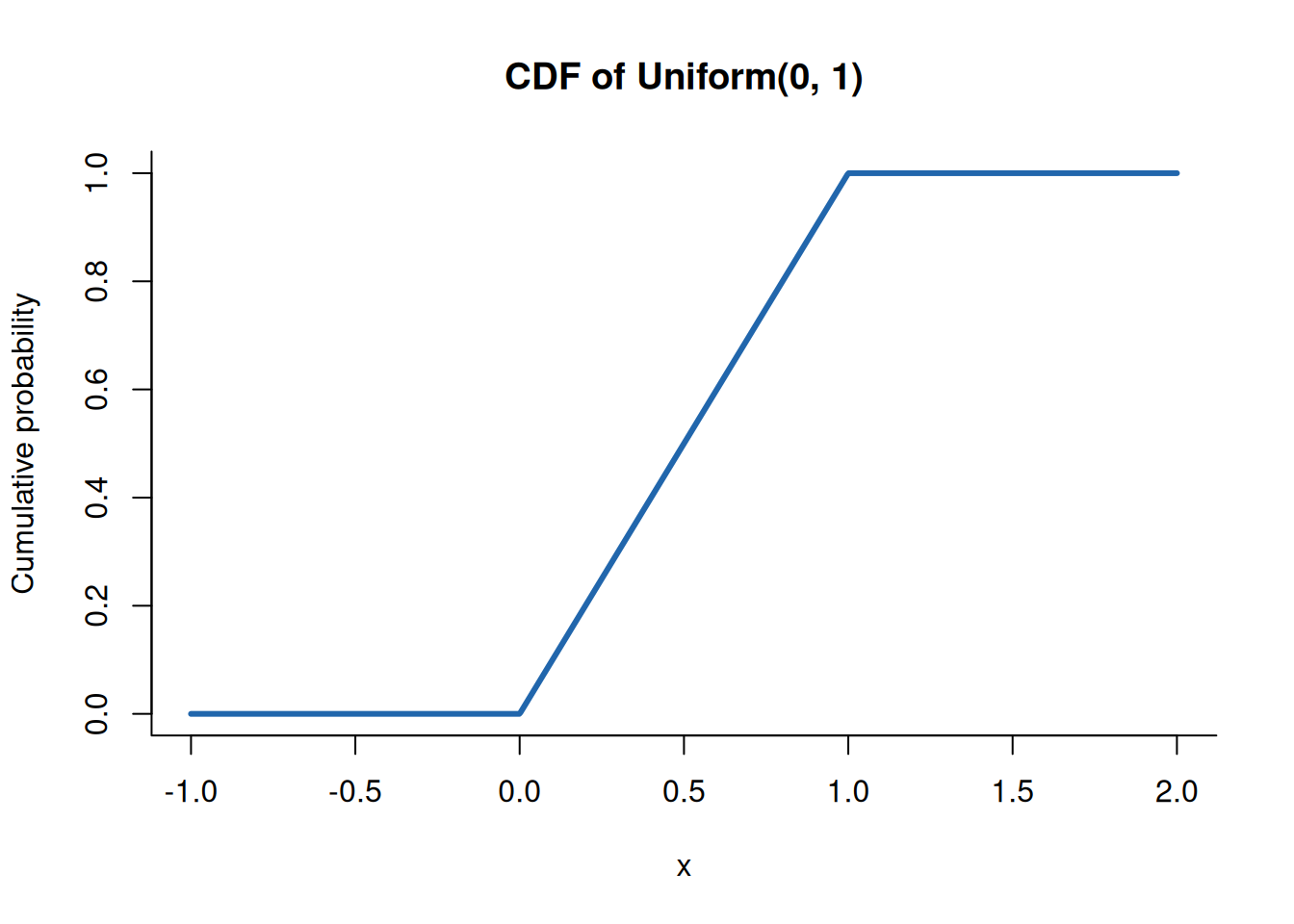
What is the probability that the cue occurs between 350 and 500 ms? The selected interval has width
500-350=150\text{ ms}.
Its probability is the rectangular area
\begin{aligned} \mathbb{P}(350\leq X\leq500) &=150\left(\frac{1}{600}\right)\\ &=.25. \end{aligned}
Every 150 ms interval fully contained in the support has the same probability. This equal area property is the meaning of uniformity.
An individual point still has probability zero:
\mathbb{P}(X=350)=0.
The family is uniform over interval widths, not positive point masses.
The mean lies at the midpoint:
\mathbb{E}[X]=\frac{a+b}{2}.
For the cue window,
\mathbb{E}[X]=\frac{200+800}{2}=500\text{ ms}.
The variance is
\operatorname{Var}(X)=\frac{(b-a)^2}{12}.
Here
\operatorname{Var}(X)=\frac{600^2}{12}=30{,}000\text{ ms}^2.
The mean describes the center of repeated random cue placements. It does not make 500 ms more likely than another exact value in the window.
dunif(400, min = 200, max = 800)
punif(500, min = 200, max = 800) -
  punif(350, min = 200, max = 800)
(200 + 800) / 2
(800 - 200)^2 / 12
The four results are the density height, interval probability, mean, and variance.
If the support is (0,.5), its width is .5 and its density height is 2. The total area remains
.5(2)=1.
The height exceeds one because it is measured per unit of X. It is not itself a probability.
Under a continuous uniform model, every point has probability zero. Equal width intervals, not individual points, have equal positive probability.
The distinction matters when a randomization program uses a finite set of integer millisecond times. That implementation is discrete, even if a continuous uniform family is a useful approximation.
The uniform family fixes density height across a bounded interval. The next page retains a bounded support while allowing density to change across it.